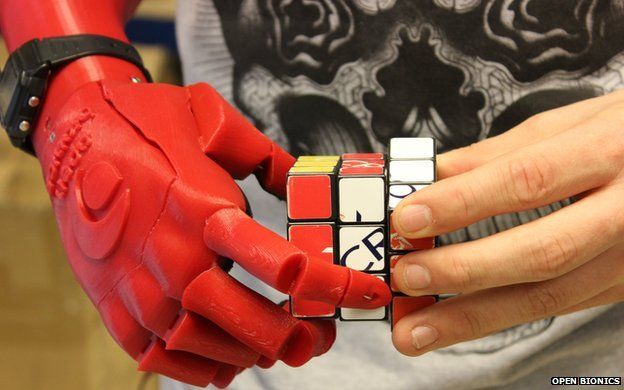
“A prototype 3D-printed robotic hand that can be made faster and more cheaply than current alternatives is this year’s UK winner of the James Dyson Award.” (BBC News link)
This is a fantastic idea, which has so much value to people without limbs. Bionic prosthetics can cost up to £100,000, and £30,000 for a single hand.
The 3D-printed robotic hand in the article costs £2,000, which is the same price as a prosthetic hook, and offers similar functionality to the top-of-the-range options.
The designer gets to develop his interest in creating a product, while helping the estimated 11 million people who are hand amputees worldwide.
I listened to an interesting podcast today, exploring the game Rock, Paper, Scissors, prediction patterns and game theory.
Being clever isn’t an effective way of winning, as people are rarely perfect decision makers. The Nash equilibrium is only relevant to domains with perfect decision makers. So it is important to consider the choices of others.
In the podcast, it was mentioned that from large datasets:
“The biggest chunk of people will think one step ahead, the next biggest chunk of people will think totally randomly, the next biggest chunk of people will think two steps ahead, and a small number of people will go beyond two steps.”
It also considers crowds and groups influencing decisions.
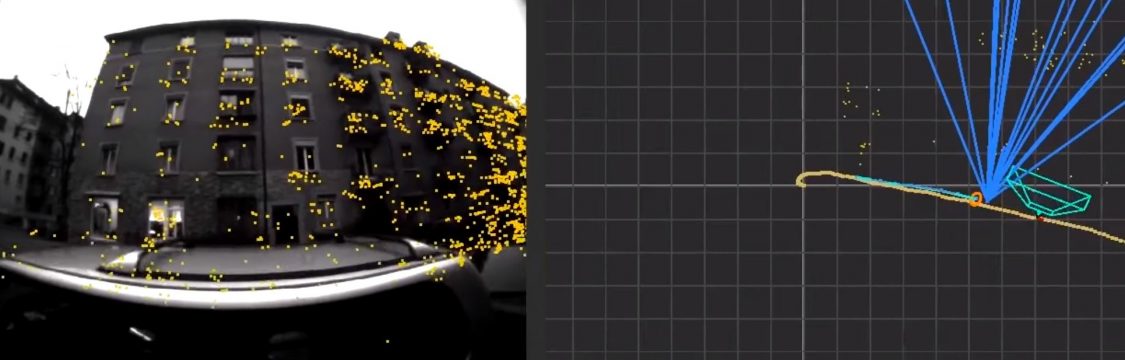
This project entitled “Large-Scale, Real-Time, Visual-Inertial Localization” is interesting, using Google’s experimental ‘Tango’ hardware to improve real-time tracking of location and position.
The hardware is a tablet computer with a motion tracking camera, a 4 megapixel 2µp pixel camera, integrated depth sensing and a high-performance processor. This equipment aids in tasks like scanning rooms. A limited number of kits were produced and given or sold to professional developers with the intent of making technological developments.
One day we may see more accurate and interesting augmented reality. I’ve often thought overlaying information onto our current reality would be interesting. Walking down a street and seeing for-sale signs could be interesting. It may just being overloaded in advertising, making a virtual eyesore though.
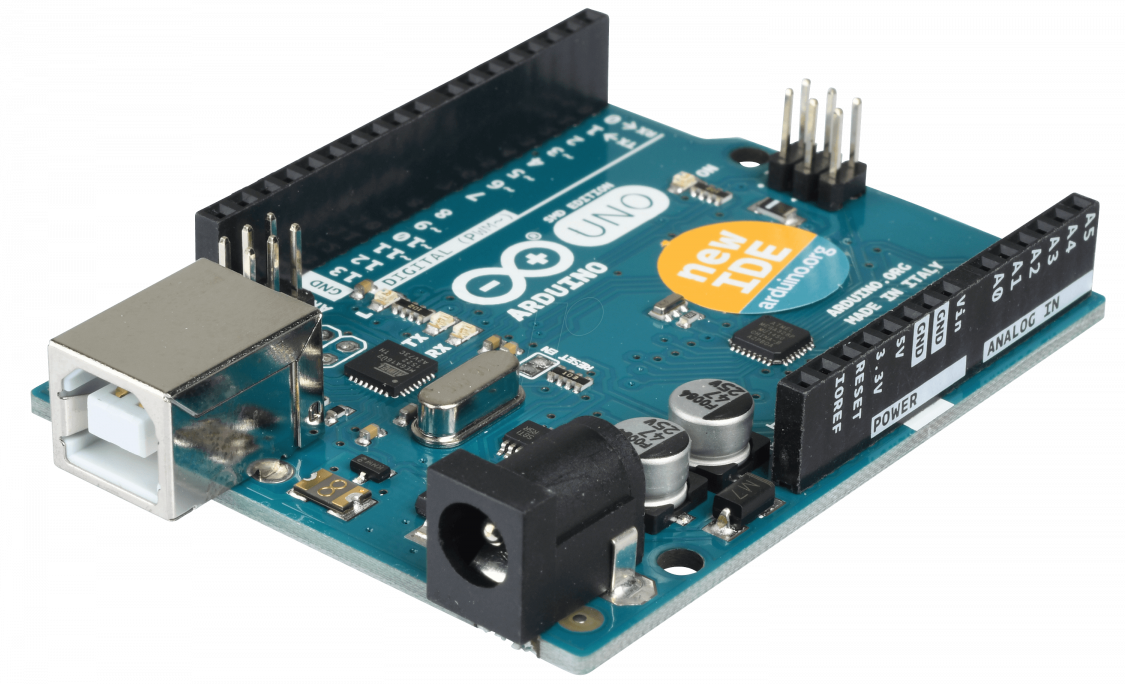
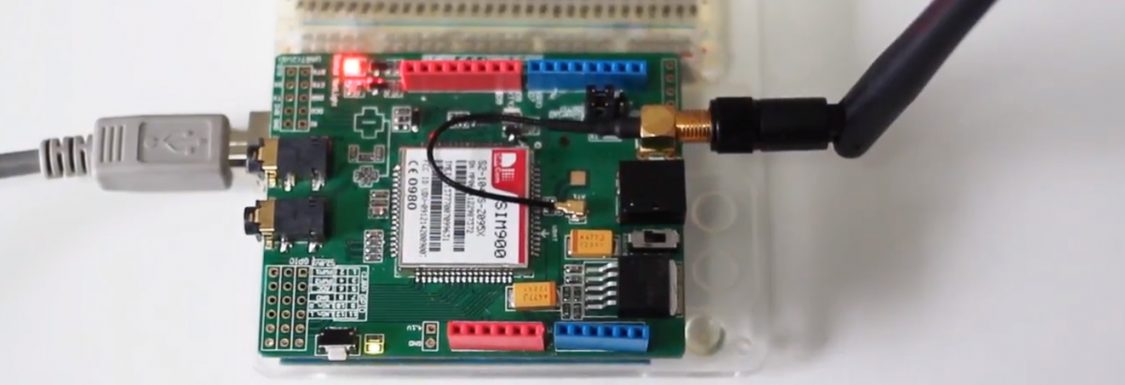
Today I used an Arduino reprogrammable electronics board and a GSM/GPRS modem to send data to the Internet. This will be useful for the sensors I intend to build.
You can see a video of it operating below. One window shows the output from the serial interface as it makes a request to my web server and outputs the response, and the other window displays the access logs on my web server.
I used a software UART (parallel and serial data converter), as using the Arduino’s built-in serial interface caused conflicts. Learning to use a software UART is going to be very useful for the next step in the project.
I did consider making a Cat Facts for Arduino, but I resisted the distraction.
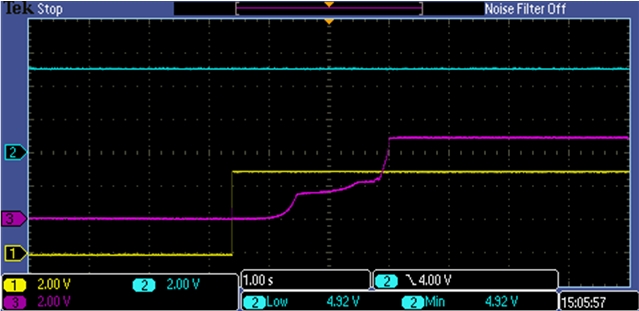
I didn’t have any issues with power spikes causing a reset (the GSM board uses a lot of power) as this is a version 2 board with soft start circuitry:
The only stumbling point I had was when the GSM modem was set to a different baud rate than my software serial interface. To change this, I sent the AT command AT+IPR=9600 to reconfigure the modem.
I learnt that AT commands are also used to send and receive via TCP/UDP. This made it much more straightforward than some kind of low level system I had imagined. All that is required from the Arduino is to send AT commands (e.g. AT+CIPSEND=) and listen for incoming responses.
—
Explanation for non-techies:
I made an electronic circuit that can send information to the Internet. This will be useful for making a sensor e.g. a temperature sensor for an office that is accessible on any computer/smartphone.
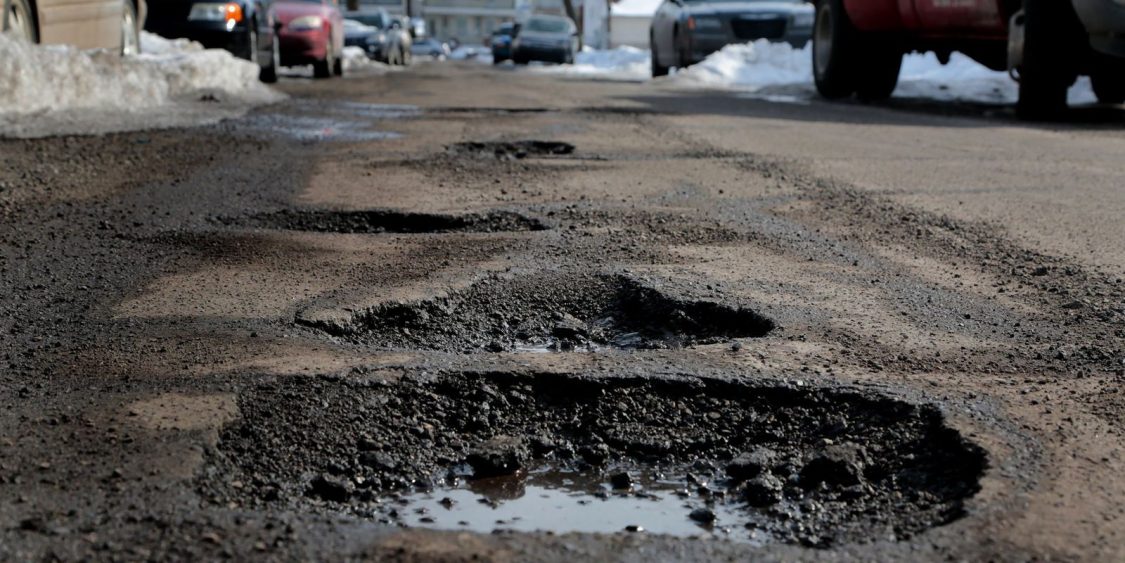
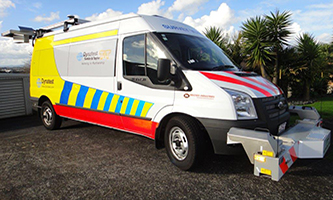
Interesting work by a team led by Nottingham Trent University on making a mobile scanner that can detect early signs of potholes. It uses conventional cameras, 3D scanners and computer vision to detect ‘ravelling’. Moving this around at traffic speed mounted to a vehicle, and combining it with GPS and a suitable logging system, it could be used to improve road conditions.
Researchers are developing smart scanning technology using existing cameras to detect the early signs of potholes and determine their severity.
The technology, developed by a team led by Nottingham Trent University research fellow Dr Senthan Mathavan, scans roads for ravelling — the loss of aggregates from the asphalt which leads to potholes and cracks.
Ravelling — an early indication of potholes — Source
Combined with 2D and 3D scanners on a pavement monitoring vehicle, a computer vision algorithm can examine the road with accuracy at traffic speed during day or night.
The system works by detecting different textures of the road to identify ravelling and distinguishes it from shadows and blemishes such as tire marks, oil spills and recent pothole repairs.
“It’s imperative for authorities across the world to be able to monitor road conditions efficiently and safely,” said Dr Mathavan, a research fellow of the School of Architecture, Design and the Built Environment.
“For the first time, academic research has addressed the issue of detecting ravelling in an automated way, which has led to the development of this novel software which can be used across the industry.”
The research was published today in Transportation Research Record, a leading academic journal for transportation infrastructure research. It also involves Dr Mujib Rahman of Brunel University, Martyn Stonecliffe-Jones of Dynatest UK Ltd, and Dr Khurram Kamal of the National University of Sciences and Technology in Pakistan.
During the research, the team found that the technology detected road surfaces correctly in all 900 images tested. It took approximately 0.65 seconds to 3D process the ravelling measurements, but it is believed that this could be reduced further.
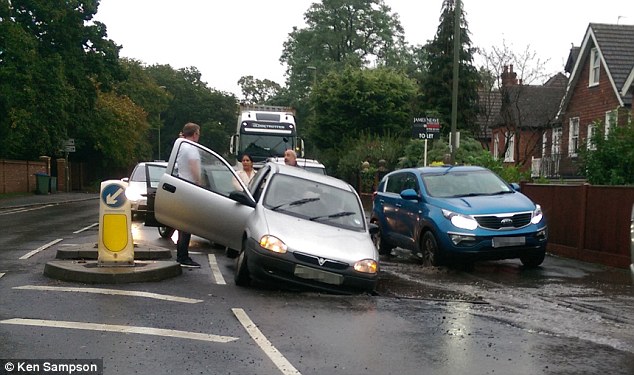
Dr Rahman added: “Potholes, in their worst potential form, can create dangerous driving conditions and cause costly damage to vehicles.
“What this technology allows us to do is capture better quality information on road conditions, without disrupting the flow of traffic or incurring unnecessary costs.
“This could be a significant step forward in the way that potholes are managed, helping improve the timeliness and efficiency of repairs.”
Atmel Studio now has an extension designed as a simple alternative to the Arduino IDE.
The Arduino IDE is relatively simple. It is great to get started with AVR programming, and has some useful examples to get you started, but lacks many of the features that experienced programmers call for like detailed compiler warnings, debugging capabilities, auto-completion and unit testing.
Arduino IDE
Programming for AVR at a lower level in Atmel Studio can also have performance improvements. Shifting bits rather than using Arduino IDE’s ‘digitalwrite’ can have a 10x speed improvement for example.
Atmel Studio supports a wider range of AVR microchips. This can be useful if you aim to program one of Atmel’s huge range of microchips. I have a ATtiny13A, which uses considerably less power than the ATMega328 in my Arduino board (190 µA in active mode, and 24 µA vs. 0.2 mA in active mode, 0.1 µA in power-down mode, and 0.75 µA in power-save mode).
So if you feel you are outgrowing the Arduino IDE, give Atmel Studio a try. You may find this tutorial useful: Using Atmel Studio 6 with Arduino projects, or How to Setup Atmel Studio for Arduino Development.
Simplicity can be more important though, and the Arduino IDE may be more suitable for your application. After all, projects are generally relatively simple when you have less than 16 KB of memory to play with. I expect I will continue using the Arduino IDE primarily, and Atmel Studio for any particularly challenging projects.
Simple explanation for non-techies
Arduino refers to a few types of tiny electronic board with a reprogrammable microchip. Programs can be sent from a computer to this microchip to perform whatever task is required.
A fun example is Leah Buechley’s Turn Signal Biking Jacket project, shown in the video below:

 Interesting work by a team led by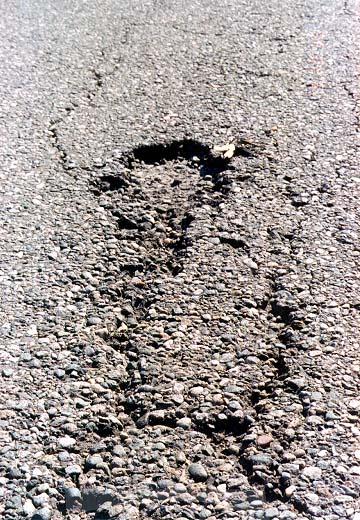
 Dr Rahman added: “Potholes, in their worst potential form, can create dangerous driving conditions and cause costly damage to vehicles.